BOMBANANA!
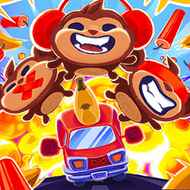
You press the button and the timer starts ticking down. You cannot see the wires, only rough shapes under your fingers, and the two other monkeys crammed into the van are shouting words that get cut off before they land. This is a normal first ten seconds in BOMBANANA!, a game where three players share one bomb and almost none of the same information.
| Genre | Cooperative bomb-defusal puzzle |
| Players Required | Exactly 3 |
| Campaign Levels | 30 |
| Achievements | 23 |
| Extra Modes | Endless, Custom |
Blind, Deaf, and Mute: Meet the Squad in BOMBANANA!
The whole setup rests on three roles, and each one is missing something the other two have. The Blind Monkey is the only player who can physically touch the bomb, but the screen is dark, so everything comes through silhouettes, texture, and guesswork. When a Braille panel shows up, the Blind Monkey is the only one who can feel it out, and describing a bump pattern to teammates who cannot see it is where most rounds start falling apart. The Deaf Monkey can see every diagram and printed instruction clearly but hears nothing the other two say, so warnings and countdowns have to travel through gestures instead of words. The Mute Monkey usually has the clearest overall picture of the bomb but cannot speak a single syllable, which turns simple callouts into a frantic round of pointing and mouthing.
None of these roles is designed to be solved alone, and that is the entire point. A player who is used to being the one who explains everything in a co-op game has to sit back here, because the Mute Monkey physically cannot narrate the solution out loud.
Rotating roles between rounds matters more than most new groups expect. Someone who struggles badly as the Blind Monkey in an early bomb often turns out to be sharp as the Deaf Monkey once they can actually see the panel they are trying to describe.
Braille Panels and Morse Code Inside BOMBANANA!
Two modules tend to define a group’s first few sessions. Braille panels ask the Blind Monkey to feel out raised dots and relay a pattern that only makes sense once someone with sight cross-references it against a printed key. The Morse code module flips that same problem around, forcing the Deaf Monkey to watch a blinking light and somehow convert timing into dots and dashes for teammates who cannot hear the difference between a short beep and a long one. Neither module is mechanically difficult in isolation; a single competent player could clear either one in seconds.
What makes them hard is the translation step. Every module hides its solution behind a sense one specific player does not have, so a five-second puzzle becomes a ninety-second negotiation.
Community threads still argue about the Morse code module more than almost anything else in the game, since the timing window feels unforgiving to groups who have not settled on a shared counting rhythm yet, and that friction is honestly one of the more divisive parts of the whole experience.
Why the Bomb Timer Changes How Groups Communicate
Every round drops the trio into the van with a live bomb, a stack of modules, a countdown, and a limited number of mistakes before things go up. Early in the game the timer is generous enough that groups can afford to double-check a callout before acting on it, which hides a lot of communication problems that surface later.
By the time a group reaches the harder rows of the 30-level campaign, the same mistakes that used to be recoverable start ending runs outright, and a wasted ten seconds arguing about which wire someone means can be the difference between defusing and detonating.
This is also where the mistake limit starts to matter. A group that has been guessing its way through Braille panels instead of actually building a shared vocabulary for shapes tends to burn through its allowed errors fast, and that pressure is what pushes most groups toward Custom mode to practice a single weak module on repeat.
Campaign Structure and Progression in BOMBANANA!
The main Campaign runs 30 levels, and difficulty climbs less through harder individual modules and more through stacking several module types onto one bomb at once. A level that only asks the group to handle one Braille panel plays very differently from a later level that layers a Morse code sequence on top of it under a tighter timer.
Beginners almost always underestimate how much of the difficulty curve is really about vocabulary. A group that never agrees on consistent shape names for the Blind Monkey’s panels will keep re-explaining the same concept every single round, and that repeated overhead compounds badly once the timer gets shorter.
Finishing the full Campaign and finishing everything else are two different goals, and most groups notice the shift once the story-driven bombs run out and only Endless and achievement cleanup are left.
Endless and Custom Modes for Practice and Chaos
Once the Campaign stops being the main draw, most groups split their time between two very different modes. Endless mode strips away the story wrapper entirely and just keeps handing out bombs back to back, which rewards a group that has already built solid shorthand and wants to see how long that shorthand holds up under fatigue.
- Endless mode keeps generating bombs back to back with no story wrapper, aimed at groups chasing longer streaks
- Custom mode lets a group dial in bomb difficulty, timer length, module types, and how many mistakes are allowed
- Custom is the main tool for isolating one weak module, like Morse code, without unrelated difficulty getting in the way
Groups who want to fix a specific weakness, rather than wait for a random late-Campaign bomb to test it, lean heavily on Custom mode instead. Turning off every module except the one giving a particular player trouble turns a stressful failure state into a repeatable drill.
Some players describe this kind of self-inflicted argument as the argument simulator side of the game, a phrase that started as a joke about the premise and stuck around because it is not far off from how a rough session actually feels.
The Emote Wheel and Talking Without Talking
Since two of the three roles cannot use their voice or their ears normally, most of the actual coordination in BOMBANANA! ends up running through the Emote wheel, pointing, and exaggerated body language. Waving frantically at a specific corner of the bomb communicates more than most sentences would, and groups develop their own shorthand gestures within a session or two.
Some players describe this side of the game as closer to charades than to a traditional puzzle title, and that comparison is not far off.
A newer player type, the one who wants clean logical puzzles with a readable solution, tends to bounce off this part hardest, while players who enjoy pure chaos and improvisation usually end up loving exactly this friction.
What does the Blind Monkey actually see in BOMBANANA?
The Blind Monkey plays on a mostly dark screen, perceiving the bomb only through vague silhouettes and touch feedback rather than full visuals. Reading a Braille panel is done entirely by feel, which is why relaying its pattern accurately to sighted teammates is one of the hardest communication tasks in the game.
Can BOMBANANA! be played with two players instead of three?
No. The game is built around exactly three roles, Blind Monkey, Deaf Monkey, and Mute Monkey, and it will not start with two players or run in a solo mode. Rounding up a full trio before sitting down is a hard requirement, not a suggestion.
What is the hardest module for most groups in BOMBANANA?
Reactions vary, but the Morse code module comes up most often in discussions about difficulty, since it depends on a Deaf Monkey converting blinking timing into dots and dashes under pressure. Braille panels cause similar trouble for groups that have not agreed on shared vocabulary for shapes.
Three monkeys, one bomb, and almost no shared information is the entire premise BOMBANANA! is built on, and it works because none of the roles can quietly carry the other two. A good run rarely comes down to one player solving the Braille panel correctly; it comes down to a Deaf Monkey and a Mute Monkey trusting a gesture they only half understood, and that trust is what keeps people coming back for another bomb.