Slope Tunnel
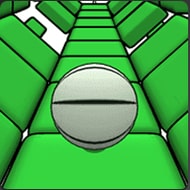
You steer left a half second too late, clip the edge of a green platform, and watch your run end mid-tunnel with the orb count sitting just below your last best score. Slope Tunnel puts you inside a rotating hexagonal tube where the ball never stops accelerating, and every small hesitation compounds the moment the walls start spinning faster than you expect.
How the Ball Moves Through the Tunnel
The ball in Slope Tunnel rolls forward automatically the instant a run starts, and your only job is steering it left or right using the arrow keys or A and D. There is no separate jump button, which surprises players coming from Slope, since clearing gaps here depends entirely on staying on the green platforms rather than timing a leap.
Falling off happens the moment the ball drifts onto anything that isn’t a marked green surface, and because the tunnel itself rotates around you as you move, judging where “left” and “right” actually lead becomes harder the longer a run continues. Tunnel vision is the exact term players use for this, describing the tendency to stare only at the platform directly ahead and miss the wider rotation pattern until it’s too late to react.
Orb Collection and Score Trade-Offs
Small orbs scattered along the path add to your score when collected, and picking one up also slightly reduces the ball’s current speed, which experienced players use deliberately during the tightest sections rather than treating orbs as optional bonus points. Chasing every single orb on the path, though, is a common way beginners lose runs, since detouring toward a distant orb often means missing the platform lane it was sitting near.
By the time a run passes the first minute or so, the tunnel’s rotation speed and platform gaps both increase noticeably, and the safest approach becomes staying centered rather than hugging one wall for a stretch of orbs.
What Beginners Get Wrong
New players tend to make large, sudden steering corrections the moment they see a gap coming, which overshoots the ball past the next green platform entirely. Slope Tunnel rewards small, continuous adjustments instead, since the ball’s momentum carries it further than a single quick tap suggests.
What happens when you finally clear a stretch of tightly clustered gaps without touching an orb is a strange kind of relief specific to Slope Tunnel, since the game gives you no finish line to celebrate, only a growing distance counter and the knowledge that the next section is already spinning faster. Getting comfortable with the ball’s automatic momentum, rather than fighting it with oversized corrections, is what actually turns a short attempt into a long one.