Family Secrets 1: Empty Plate
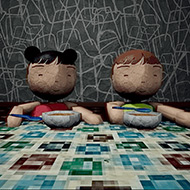
What does Family Secrets 1: Empty Plate actually have in common with Bad Parenting? Enough that players discussing it online have directly called Empty Plate an inspired-by rather than a copy — a domestic horror story built on a similar foundation of childhood neglect, but telling its own separate story through Miko and Jun rather than continuing anyone else’s.
Shared Ground: Domestic Horror Without Combat or Puzzles
Both games strip out the usual horror-game toolkit. Family Secrets 1: Empty Plate has no weapons, no inventory, and no puzzle-solving layer — just movement, interaction, and a flashlight for darker rooms. That minimalism is exactly what draws the comparison from players familiar with the wider genre of home-based, child’s-eye-view horror games: the tension comes from the situation itself rather than from any system built to threaten the player mechanically.
Players who gravitate toward this specific corner of horror tend to be less interested in reflexes or resource management and more interested in atmosphere and emotional weight, which is exactly where Family Secrets 1: Empty Plate spends almost all of its runtime.
The house itself does a lot of the same narrative work across this style of game — ordinary rooms, normal furniture, nothing overtly monstrous — which is part of why the horror lands as uncomfortable rather than fantastical.
What Actually Separates Empty Plate From a Longer Series
Where the comparison breaks down is scope. Family Secrets 1: Empty Plate runs about 30 to 40 minutes and tells one compact, self-contained story about Miko and Jun rather than spreading events across a longer campaign or multiple entries. Comments from players who finished it consistently describe it as tightly focused, with some explicitly hoping for a continuation given how the story ends.
This shorter runtime changes how the horror is paced compared to a more drawn-out game in the same style — Empty Plate doesn’t have room for a slow build across multiple in-game days, so its tension has to accumulate faster, largely through dialogue, the state of the house, and the growing sense that Miko is handling more than he should have to.
A Genuinely Divisive Point Among Players
Not everyone who played it wanted the same thing out of the experience. Some players who came in expecting frequent scares openly noted there were fewer jump-scare moments than they anticipated, while others praised the same restraint as the reason the ending hit as hard as it did. That split is worth knowing going in, since Family Secrets 1: Empty Plate leans much closer to psychological horror and tragedy than to a startle-driven horror game.
The developer has acknowledged this is early work and described it as a second project while still learning game development, which several players have pointed to when discussing where a sequel might take the story next.
Is Family Secrets 1: Empty Plate connected to Bad Parenting?
It’s not an official continuation, but players and even some of the game’s own promotional material have described it as directly inspired by Bad Parenting’s approach to domestic horror. The story, characters, and setting in Family Secrets 1: Empty Plate are original and separate from that series.
Does Family Secrets 1: Empty Plate have jump scares like other horror games?
It has some, but multiple players have specifically noted fewer jump scares than they expected going in. The horror leans more on atmosphere, dialogue, and the emotional weight of Miko and Jun’s situation than on sudden scare moments.
Will there be a Family Secrets 2?
Nothing has been formally confirmed, but the numbered title and the open-ended way the first game closes have led several players in the comments to explicitly ask for and anticipate a continuation.
Even without weapons, puzzles, or a large cast, Family Secrets 1: Empty Plate carries its comparison to Bad Parenting on tone alone — and Jun’s role in that final stretch of the story is exactly why players keep bringing the two up in the same breath.