Fart Together
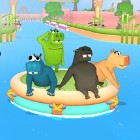
Fart Together looks like a silly party game about hippos and gas, but keeping a shared raft on course takes real coordination. Two to four players work together, using fart power to steer, build momentum, and cross obstacle courses without sending everyone drifting into trouble. The joke is immediate, yet the central challenge is surprisingly clear: each burst changes the raft’s movement, so one player’s badly timed input can undo everyone else’s careful approach. There are no established named heroes or named zones to memorize; the shared raft, the hippos, and the obstacles are the focus.
| Genre | Physics-based cooperative obstacle course and party game |
| Players | 2–4 in co-op |
| Platform | Windows PC |
| Core mechanic | Steer a shared raft by timing and directing fart-powered bursts |
Steering the Shared Raft in Fart Together
The important thing to learn early in the game is that thrust is also steering. A burst can push the raft forward while changing its angle, which means holding the input for too long may carry the whole crew away from the intended line. Short corrections are usually safer near a narrow passage, while a more committed burst makes sense when there is room to recover. Treat each input as a team decision rather than an individual attempt to move faster.
New players often react to every wobble by pressing harder. That tends to create more sideways drift and makes the next correction even harder to judge. Instead, pause briefly, read the raft’s direction, and use a controlled burst to straighten out before accelerating again. The funny part is how quickly a confident run can turn into a group argument over who caused the raft to veer off course.
Players who enjoy precision platforming will likely appreciate the small adjustments needed to line up with an opening. Friends who prefer chaotic party games may enjoy the same moment for the shouting and accidental wipeout. Both approaches work best once everyone understands that the raft responds to combined inputs.
Timing Fart Power Through Obstacles
Fart Together rewards timing more than constant output. On open stretches, coordinated bursts can build useful momentum, but tight corners and moving obstacles call for restraint. Before entering a hazard, watch its movement long enough to spot a safe window, then agree on when to move. If the crew fires at different moments, the raft can twist while crossing the danger zone and clip an edge that looked easy to avoid.
A useful habit is to call the maneuver before making it: straighten first, turn second, and accelerate only when the raft is aligned. Near a narrow gap, feather the controls rather than holding them down. After a collision or failed attempt, reset the team’s orientation and try again without rushing to repeat the same mistake.
Players who like co-op games built around communication can turn simple callouts into a real advantage. The game is at its funniest when a plan falls apart, but repeated failures become frustrating if nobody changes the timing. One calm player calling the next move can be more useful than four people trying to correct the raft at once.
Why Fart Together Gets Tougher With Friends
The shared control scheme is the source of both the comedy and the difficulty. Every player affects the same vehicle, so individual reactions do not always add up to a sensible group movement. The course design asks the team to handle sharp turns, tight spaces, and moving hazards while preserving enough control to recover from small errors. There is no need to memorize a roster of special abilities: learning the raft’s response is the main skill.
Community discussion around the demo often uses familiar co-op language such as “carry,” “wipe,” and “one more try.” Those terms fit the loop: one player may rescue a messy run with a well-timed correction, while a single mistake can force the whole group to start a section again. Some players love the chaotic physics; others find the controls frustrating when teammates cannot coordinate or when a group gets stuck repeating the same obstacle. That tension is central to the game, not a hidden story or character system.
For a group that enjoys learning through failure, the best progress comes from making one adjustment at a time. If the raft keeps clipping the same corner, reduce thrust before the turn instead of adding more power at the last second. If the team drifts while approaching a moving obstacle, wait for a clearer opening and launch together. The goal is not simply to produce the biggest burst, but to make the raft travel where the crew intends.
Fart Together Questions Players Ask
How do you steer the raft in Fart Together?
Use fart-powered bursts to influence the shared raft’s direction and momentum, and pay attention to how each input changes its angle. Short, controlled corrections help you line up with narrow passages, while longer bursts are better suited to open stretches. If the raft starts drifting, stop adding power for a moment and realign before trying to accelerate again.
Can you play Fart Together alone or with a small group?
The main co-op design is built around 2–4 players sharing one raft, so coordination is the defining part of the game. A two-player crew has fewer voices to coordinate, but each person’s timing still matters because both affect the same movement. The most reliable approach is to communicate turns and bursts clearly rather than having everyone react independently.
Why does the raft keep crashing in Fart Together?
Most failed runs come from mistimed bursts, too much thrust near a corner, or players correcting in conflicting directions. Watch moving obstacles for a moment before committing, enter narrow gaps with the raft aligned, and save stronger bursts for places with room to recover. If the same section causes repeated wipes, change one part of the approach instead of repeating the exact timing.
Fart Together works best when the crew learns to treat the shared raft as one vehicle rather than four separate plans. Once the hippos coordinate their fart power, narrow passages become manageable and moving obstacles feel less like random punishment and more like timing tests. The game still leaves room for ridiculous wipeouts, but a well-called burst can turn a chaotic run into a satisfying team save.