Hover Racer Drive
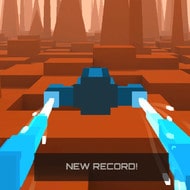
What happens the instant your hovercraft clips a single obstacle in Hover Racer Drive? The run ends immediately, with no damage buffer or second chance, which is exactly why players treat every ring and gap on the track with more respect than the smooth, floaty controls initially suggest.
| Genre | Hovercraft distance racer |
| Core Loop | Fly as far as possible while collecting credits |
| Controls | A/D or arrow keys to steer |
| Progression | Spend credits on upgraded hovercraft |
Steering the Hovercraft Through Procedural Tracks
Your hovercraft moves forward on its own the moment Hover Racer Drive starts, and steering left or right is handled entirely through A and D or the arrow keys, with no acceleration input needed since speed increases automatically the longer a run continues. Because the world generates procedurally rather than from a fixed layout, memorizing a path never works, and every run demands fresh reads of upcoming obstacles rather than relying on a previous attempt’s timing.
- Colored hoops along the path add credits and a brief speed bonus when flown through cleanly
- Obstacles end the run instantly on contact, with no partial damage state
- Speed climbs continuously, meaning steering inputs that felt safe early on become overcorrections later
Players who keep steering inputs sized the same way they did at the start of a run tend to swing wildly off course once speed has climbed, since the same input angle produces far more lateral movement at higher velocity. Scaling steering down as speed increases is one of the clearer adjustments separating longer runs from short ones.
Credits and Hovercraft Upgrades
Credits earned by flying through hoops go toward unlocking better hovercraft, and each upgraded craft in Hover Racer Drive handles differently rather than simply moving faster in a straight line. A heavier hovercraft tends to hold a line more predictably through tight sections, while a lighter one responds faster to sudden obstacle placement but punishes oversteering harder.
Some players focus almost entirely on distance and treat hoops as optional, prioritizing survival over score, while others detour slightly off the safest line specifically to chain hoops together for a faster credit total. Both approaches show up regularly in Hover Racer Drive discussions, and which one suits a given run often depends on how the obstacle field is generating that particular attempt.
What Beginners Get Wrong
New players commonly react to obstacles only once they’re close to the hovercraft’s current position, which works at low speed but fails once speed scaling has kicked in a minute or two into a run. Reading obstacle clusters as they first appear at the edge of view, rather than waiting until they’re near, gives enough lead time to make small corrections instead of last-second panic turns.
FAQ
Why does the hovercraft handle differently than a regular vehicle?
Because it hovers rather than grips the surface, the craft in Hover Racer Drive drifts slightly through turns instead of gripping instantly, which means players need to ease into direction changes rather than snapping the input the way they might in a standard car game.
What is the fastest way to earn credits in Hover Racer Drive?
Chaining colored hoops together in a single run adds both credits and short speed bonuses, and stringing several in a row without detouring far off the main path earns more per run than chasing scattered hoops individually.
Does upgrading the hovercraft make the game easier?
Upgraded hovercraft change handling characteristics rather than simply reducing difficulty, so a heavier craft holds steadier through obstacle clusters while a lighter one still requires precise, scaled-down steering once speed climbs.
Hover Racer Drive stays tense specifically because there’s no forgiveness built into a single mistimed pass through a hoop cluster, and that instant-fail design is exactly what keeps players tightening their steering discipline run after run. Learning to scale input size down as speed increases, rather than trusting the same steering habits from the opening seconds, is the actual skill the game is testing underneath its floaty hovercraft aesthetic.