Dirt Clicker
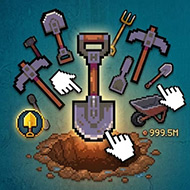
You tap the patch of dirt once, twice, a dozen times, and the counter barely moves — then somewhere around the fiftieth click something shifts and the numbers start climbing on their own. That moment is the whole hook of Dirt Clicker, a browser-style incremental game built around a single loop: click dirt, earn Dirt, spend Dirt on tools that generate more Dirt without you touching anything. It sounds almost too simple to hold attention, but the game leans hard into the incremental genre’s oldest trick — steady, visible progress that keeps pulling you back for “just one more upgrade.”
The Core Loop Behind Dirt Clicker
At its foundation, Dirt Clicker asks very little of the player: click the dirt tile, watch the resource total tick upward, and reinvest that total into passive generators. Early on, every click matters because there’s no automation yet, so the game is trying to teach patience before it starts rewarding it. Once the first Shovel is purchased, the loop changes shape entirely — Dirt now accumulates whether or not you’re actively clicking, and the player’s job shifts from “producer” to “manager” of a small digging operation.
What keeps this from feeling like a chore is the pacing of unlocks. A new tool tier — Shovel, then Pickaxe, then Drill — arrives just as the previous one starts to feel slow, which is a deliberate incremental-game rhythm rather than an accident. Players who’ve spent time with Cookie Clicker or Clicker Heroes will recognize the cadence immediately; Dirt Clicker doesn’t try to hide that lineage, it just applies it to dirt instead of cookies or monsters.
The game rewards players who check in periodically rather than those who sit and mash the tile nonstop. Idle accumulation while the tab is open (or, depending on the build, even while it’s closed) means the smartest strategy is often to buy the next generator and walk away for a while rather than grinding clicks by hand.
What New Players Get Wrong Early
The most common mistake in Dirt Clicker is spending every unit of Dirt the instant it’s available instead of saving toward the next tier of generator. Buying five cheap Shovels feels productive, but a single Pickaxe often produces more per second than several Shovels combined once the math catches up. Players coming from other clicker games sometimes bring that same instinct in, and it takes a run or two before the pattern clicks — pun intended.
Another early misstep is ignoring passive income entirely and just clicking manually for long stretches. That approach works for the first minute or two but falls off hard once generators become available, since manual clicks stop scaling while automated production keeps compounding.
Difficulty Curve and Late-Game Grind
Dirt Clicker doesn’t have “difficulty” in the traditional sense — there’s no combat, no fail state — but it does have a curve of diminishing returns that functions the same way a difficulty spike would in another genre. Costs for each new tool rise faster than early production does, so by the time you reach the Drill tier, the game is quietly asking for patience rather than reflexes.
- Casual players tend to check in a few times a day, letting Dirt accumulate between visits.
- Optimizers plan purchase order carefully, calculating which generator gives the best return per unit spent.
- Completionists push toward every visible milestone even after the core loop stops feeling fresh.
This is also where the game’s most divisive trait shows up: some players find the later stretch satisfying because the numbers keep growing, while others find it repetitive since no new mechanics get introduced to break up the pattern. Both reactions are common in incremental game communities, and Dirt Clicker doesn’t really try to resolve that tension — it just keeps the loop running.
Community Vocabulary and Shared Habits
Players discussing Dirt Clicker tend to borrow terms straight from the broader incremental scene: “idling” for letting the game run untouched, “buyout” for purchasing every available generator at once, and “reset” for players who restart a save to test a faster route to the same milestones. None of that vocabulary is unique to this game specifically, but it’s how the community naturally talks about it because Dirt Clicker sits so comfortably inside the clicker genre’s established habits.
Do you need to click constantly to progress in Dirt Clicker?
No. Manual clicking matters most in the opening minutes before any generators are purchased. After that, buying and upgrading tools like the Shovel and Pickaxe produces far more Dirt over time than repeated clicking ever will, so the efficient approach is to invest early and let automation carry the pace.
What’s the fastest way to unlock the Pickaxe tier in Dirt Clicker?
The quickest route is to resist spending every bit of Dirt on the cheapest generator and instead hold a reserve toward the Pickaxe’s purchase cost. Buying just enough Shovels to keep production moving, rather than maxing them out, usually gets a player there faster than spreading resources too thin.
Does Dirt Clicker keep progressing when the game isn’t open?
Idle accumulation is central to how the game’s economy is paced, which is why checking in periodically rather than clicking nonstop is the more effective long-term strategy — the generators are doing the heavy lifting once they’re in place.
Dirt Clicker isn’t trying to reinvent the incremental game — it’s a tight, dirt-themed take on a formula plenty of players already know, built around the Shovel-to-Pickaxe-to-Drill progression that gives every session a small, visible reason to come back. Whether that repetition feels relaxing or feels thin by the late stretch really depends on how much a given player enjoys watching numbers climb for their own sake, but for a game this small in scope, it delivers exactly the loop it promises.