Bubble Trouble
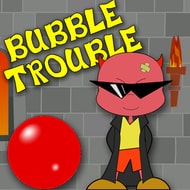
Bubble Trouble looks like a simple shooting gallery with round, bouncing targets, but it plays like a spatial math problem where every popped bubble multiplies your immediate danger instead of reducing it.
How Bubble Splitting Works in Bubble Trouble
Your harpoon fires straight up and pops whatever bubble it hits, but large bubbles do not disappear, they split into two smaller bubbles that bounce off in opposite directions. A single big bubble at the top of a level can chain down into four or more smaller bubbles by the time you finish clearing it, and misjudging that chain is how most runs end early.
Bounce timing is the skill Bubble Trouble actually tests, since bubbles fall and rebound at fixed angles off the level’s walls and floor, and predicting where a bubble will be in two seconds matters more than aiming at where it is right now.
Smallest bubbles pop completely on contact instead of splitting further, which means the last hits in a level often come fastest and require the tightest positioning against the level walls.
Level Progression and Power-Ups
Early levels in Bubble Trouble give generous space and slow bubble counts, but by level 10 or so the play area starts feeling cramped relative to how many bubbles are bouncing at once. Power-ups drop occasionally from popped bubbles, including faster fire rate and wider harpoon spread, and grabbing them fast before they expire on the ground is part of clearing later levels cleanly.
Some players prioritize popping bubbles from the top down to control the split pattern, while others clear from the edges inward to keep a safe retreat path open. Both approaches show up constantly in Bubble Trouble discussions, and neither is objectively correct since it depends on how crowded a given level’s opening layout is.
What Beginners Get Wrong
New players tend to fire at the nearest bubble regardless of size, which spawns two smaller bubbles directly into their movement path. Prioritizing the bubble whose split pattern clears the most open space, even if it is not the closest target, avoids boxing yourself into a corner.
Once a level fills with several small bubbles bouncing at high speed, panic-firing becomes common, and it rarely helps. Players who slow their aim down and track one bubble’s bounce path at a time clear crowded screens far more consistently than players trying to react to everything simultaneously.
Movement and Positioning
Your character in Bubble Trouble only moves left and right along the floor, which means vertical threats have to be solved through timing and lane choice rather than dodging freely. Staying centered gives you the most reaction time against splits from either side, while hugging a wall limits your options if two bubbles converge on your position at once.
By the time bubble counts stack up in later stages, players who camp near a single wall often get cornered by simultaneous splits, which is one of the clearest signs a run is about to end.
Bubble Trouble stays replayable because its core idea, that every bubble you pop makes the next few seconds more chaotic rather than calmer, never really goes away no matter how many levels you clear. Reading a bounce path correctly and choosing which bubble to pop first, rather than just aiming fast, is what actually separates a clean run from getting cornered near the level walls.