Dinosaur Game
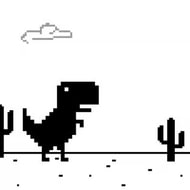
The pixelated T-Rex in Dinosaur Game does not jog, it holds one fixed run cycle no matter how fast obstacles start arriving, which is part of why the game gets harder to read the longer a run goes.
| Genre | Endless runner |
| Character | T-Rex |
| Obstacles | Cacti, pterodactyls |
| Special Feature | Night mode after certain scores |
Jumping and Ducking Mechanics
Dinosaur Game only gives the T-Rex two moves, jump and duck, and the entire challenge comes from timing those two inputs against a scrolling obstacle field that never repeats in a fixed pattern. Cacti require a jump, while pterodactyls fly at three different heights, and the lowest-flying pterodactyls actually require a duck instead of a jump, which trips up new players constantly.
Holding the jump input does not increase jump height in Dinosaur Game, since the arc is fixed regardless of how long the key is held. Players who tap quickly and release, rather than holding through the jump, tend to land back on the ground faster and regain control sooner for the next obstacle.
Cactus Clusters and Spacing
Single cacti are rarely the problem in Dinosaur Game, it is clusters of two or three placed close together that force a precisely timed jump instead of a comfortable one. Misjudging the gap between clustered cacti is one of the most common ways a run ends once speed increases past the early game.
- Single cactus: standard jump timing works reliably
- Double cactus cluster: requires a slightly delayed jump to clear both
- Triple cactus cluster: often needs the tightest timing window in the whole run
Pterodactyls and Height Variation
Once pterodactyls start appearing, usually a few hundred points into a run, they add a height variable that cacti never had. A high pterodactyl demands a duck, a mid-height one can go either way depending on your current position, and this ambiguity is exactly what community discussions around Dinosaur Game tend to focus on most.
- Track the pterodactyl’s height the moment it enters the screen edge
- Decide jump or duck early rather than waiting until it’s close
- Commit to the input fully since Dinosaur Game punishes hesitation more than wrong timing
Night Mode and Speed Scaling
By the time your score crosses roughly 700 points, the background inverts into night mode, and this is not just cosmetic, since the contrast shift makes obstacle silhouettes slightly harder to read at the same moment the base speed has already increased. Night mode toggles on and off repeatedly as a long run continues, adding a rhythm of visual difficulty spikes that players learn to anticipate rather than get surprised by.
Speed increases gradually and continuously in Dinosaur Game rather than in discrete jumps, which means a run that feels comfortable at 300 points can feel entirely different by 1500 points even though no new obstacle types have appeared.
What Beginners Get Wrong
New players often react to obstacles only once they’re close to the T-Rex, which works fine at low speed but fails once speed scaling kicks in past the first few hundred points. Reading obstacles as they enter from the right edge of the screen, rather than waiting until they’re near, is the adjustment that actually extends runs.
High Score Culture
Because Dinosaur Game has no true ending, community conversation revolves almost entirely around high scores, with many players treating four-digit scores as the real benchmark for skill rather than simply surviving a few obstacles.
FAQ
Why does the T-Rex sometimes jump the wrong height in Dinosaur Game?
Jump height is fixed and does not respond to how long the input is held, so timing rather than input duration determines whether a jump clears a cactus cluster cleanly.
What triggers night mode in Dinosaur Game?
Night mode activates once your score passes a set threshold, roughly around 700 points, and then continues toggling between day and night as the run continues.
Should you duck or jump for pterodactyls in Dinosaur Game?
It depends entirely on the pterodactyl’s flight height when it enters the screen: low-flying ones require a duck, high-flying ones require a jump, and reading that height early is more important than reacting fast.
Dinosaur Game succeeds with almost nothing on screen because its two inputs, jump and duck, create enough decision pressure once cactus clusters and pterodactyls start overlapping with rising speed. The T-Rex never changes, night mode never stops cycling, and that repetition under gradually increasing pressure is exactly what keeps players chasing one more run past their last high score.